Skip to main content Skip to footer
Menu
onekawa view onekawa view

Iwi and Hapū Resource Management Plans

Iwi and Hapū Resource Management Plans are planning documents developed by iwi and hapū which describe the resource management issues of importance to them as tangata whenua.   

The plans may also contain information relating to specific cultural values, historical accounts, descriptions of areas of interest (hapū/iwi boundaries/rohe) and consultation/engagement protocols for resource consents and/or plan changes. 

Importance of Iwi and Hapū Resource Management Plans  

Iwi and Hapū Resource Management Plans are a mechanism in which tangata whenua cultural values and interests can be considered in Council's processes. There are also specific legislative requirements which requires these plans are taken into account. In practice, local authorities must balance competing interests, including the matters expressed within Iwi and Hapū Resource Management Plans.  

Council currently uses 49 plans to inform decision making (as at December 2024).

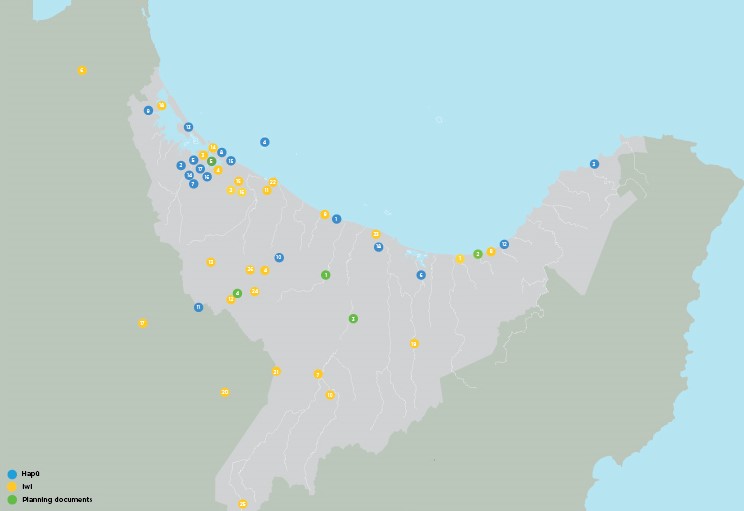
Iwi and Hapū Resource Management Plans across Te Moana a Toi

iwi hapu plan map

Funding for Iwi and Hapū Resource Management Plans

Council provides a contribution (in part) to the development of Iwi and Hapū Resource Management plans. Annual Plan funding has been allocated so that these plans can be developed, reviewed or updated. The fund must cater for any eligible hapū and iwi within the bounds of the Bay of Plenty region. All funding applications are carefully considered.  

Apply now

Complete the online application form, or if you prefer a physical form, you can download the application form. Once it is complete, send it into TeAmorangi@boprc.govt.nz

For further information please contact Te Amorangi staff at Bay of Plenty Regional Council.

  1. Only those hapū and iwi with land interests in the Bay of Plenty Regional Council boundaries are eligible to apply.  

  1. Applications must be in writing and signed by person/s duly authorised by the hapū/iwi.  

  1. The proposed plan must be recognised by the relevant iwi authority and approved by a wide representation of the hapū/iwi.  

  1. Funding will only be paid to an established Maori entity such as a marae committee, iwi authority, hapū trust or consultants acting on behalf of the applicant.  

  1. A copy of the final plan will be lodged with Toi Moana Bay of Plenty Regional Council and displayed on this page.  

  1. Please note that all recipients of hapū/iwi resource management funding agree to a copy of their hapū or iwi resource management plan (either new, revised or updated) being posted on our website.  

RMA reform

The Government has replaced the Resource Management Act (RMA) with the Natural Environment Act and Planning Act. The new system will be introduced over several years. As a result, both newly proposed and existing hapu/iwi management plans may require review to ensure appropriate alignment with the new system.

For information about the new planning system, including what is changing, when changes will occur, and how the new system is being introduced, visit the Ministry for Cities, Environment, Regions and Transport website.

Next Generation Iwi and Hapū Management Plans in the Bay of Plenty

Many iwi and hapū management plans (IHMPs) in the Bay of Plenty were developed to influence planning and resource consent processes under the Resource Management Act 1991 (RMA).

That planning environment is changing. Resource management reform is shifting more important decisions towards national direction and regional spatial planning.

At the same time, there are amendments to legislation and policy across areas such as conservation infrastructure, housing, energy, and minerals can affect iwi and hapū aspirations.

Together, these changes mean that IHMPs remain important, but they may be less effective if they do not reflect the evolving regulatory environment.

This document outlines what the changing planning and decision-making environment means for IHMPs. It provides practical guidance on how IHMPs can be reshaped and repositioned so that they remain useful and effective across different processes, audiences, and statutory contexts.

This document has been prepared for:

Iwi and hapū in the Bay of Plenty to identify where to start, what to do next and where to focus effort when reviewing on existing IHMP or preparing a new one, and

Bay of Plenty Regional Council to consider how it can support iwi and hapū, particularly in preparation for regional spatial planning.

The main change is where and when important decisions are made.  The new resource management system places greater emphasis on national direction and regional spatial planning, with fewer matters left to individual consent or permit processes.

Similar patterns are emerging through conservation reform, while local government reform may change governance structures and relationships.  At the same time, fast track legislation creates additional pathways through which decisions affecting iwi and hapū may be made.

Together, these changes shift more important decisions earlier and across a wider range of processes.

IHMPs still matter, but they need to work differently.  They continue to have formal recognition in regional planning fast-track processes.  At the same time, more important decisions are being made earlier and through a wider range of pathways.

IHMPs are more likely to be effective when they can work beyond:

  • a single Act, because legislation can be replaced and new statutory pathways created.

  • a specific process, such as resource consenting, because there will be more permitted activities and fewer consent processes.

  • a specific audience, such as a particular council or committee, because governance structures and decision-making responsibilities may change.

 When things happen is also becoming more important.  Regional spatial planning with Land Use maps showing where growth, infrastructure, environmental constraints and other priorities will occur help to inform what may be included in an IHMP.

The following elements can strengthen a next-generation IHMP.

  • Clear direction.  State what you want, not just what you don’t want.

  • Spatial clarity.  State where your priorities apply and show this where possible.

  • Flexible from.  Decide from the outset how your IHMP will be built, used and updated.

  • Broader relevance. Write for more than on audience or process.

For those with a Treaty Settlement, also consider how settlement outcomes and mechanisms could be reflected in your IHMP.

If you already have an IHMP, do not assume it needs to be replaced or completely rewritten.  Start by identifying what still works, what needs strengthening and which gaps matter most now.

If you are preparing a new IHMP, it does not need to cover every kaupapa from the outset.  Start with the priorities, places and decisions that matter most and build from there.

For the Bay of Plenty Regional Council, the priority is to support this work through flexible funding, practical technical support and early preparation for regional spatial planning.

There is an Appendix in the document that provides a quick checklist for reviewing an existing or draft IHMP.  The questions are prompted, not prescribed requirements.